Copper Breaks · Copper Breaks State Park
Watching for the Andromeda Galaxy by eye
On a dark autumn evening, a faint oval glow hangs high in the northeast. It is a whole galaxy, and its light set out long before there were people to see it.
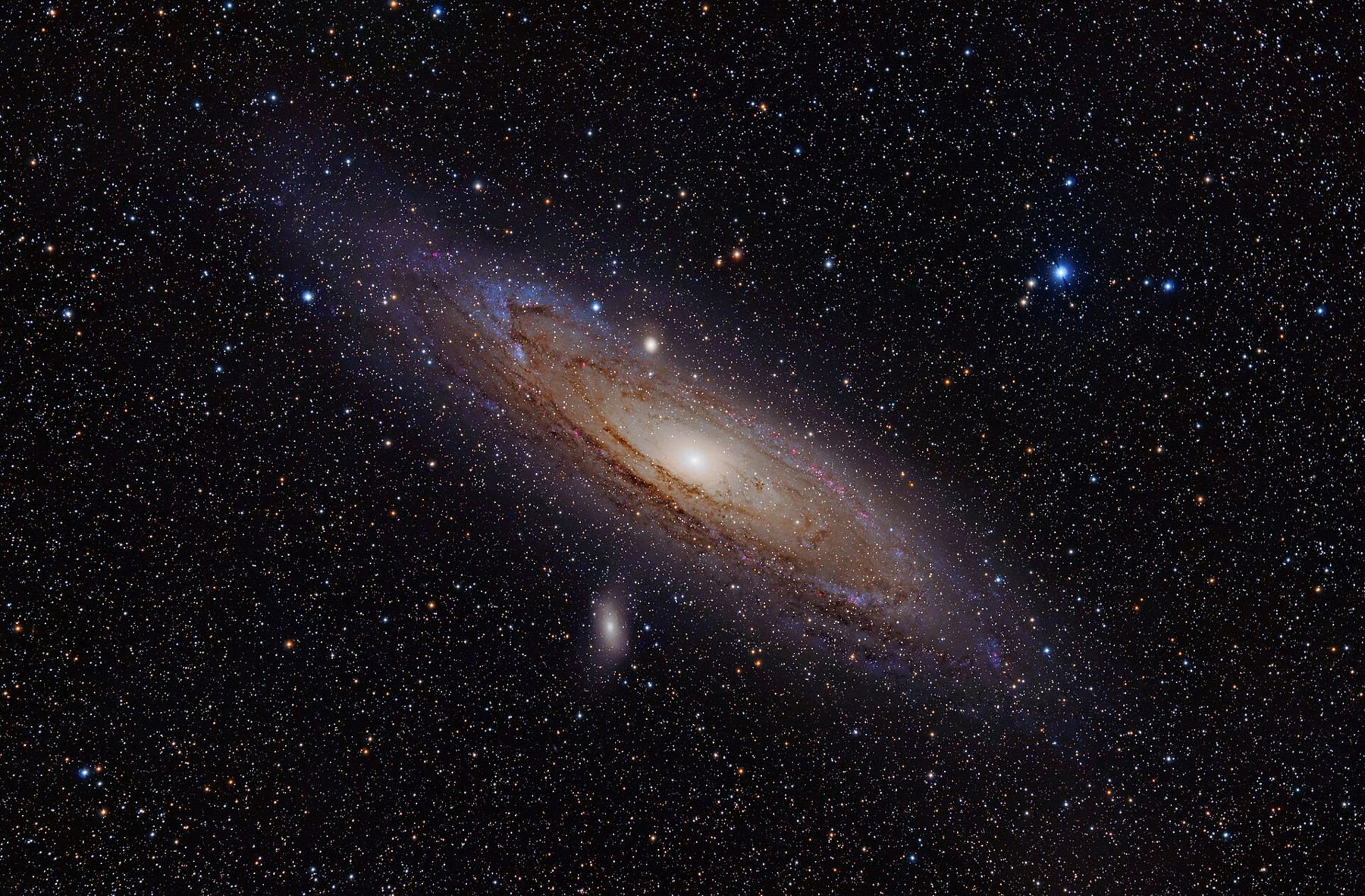
Most of what you see in the night sky is close, by the standards of the universe. The stars are neighbors in our own galaxy, and even the faintest of them are only a few thousand light-years away. Then there is a small, faint oval of light high in the autumn sky, in the constellation Andromeda. It is another galaxy, a great spiral of stars like our own, and its light has been travelling for about two and a half million years to reach you.
You can see it with nothing but your eyes, if you know where to look and the sky is dark enough. Copper Breaks State Park, an International Dark Sky Park on the Rolling Plains near Quanah, is a fine place to try.
A smudge two and a half million light-years deep
The Andromeda Galaxy, also known as Messier 31, is the nearest large galaxy to our own and among the most distant things most people can see without help. It contains hundreds of billions of stars, and it is roughly the size of our own galaxy, or a little larger.
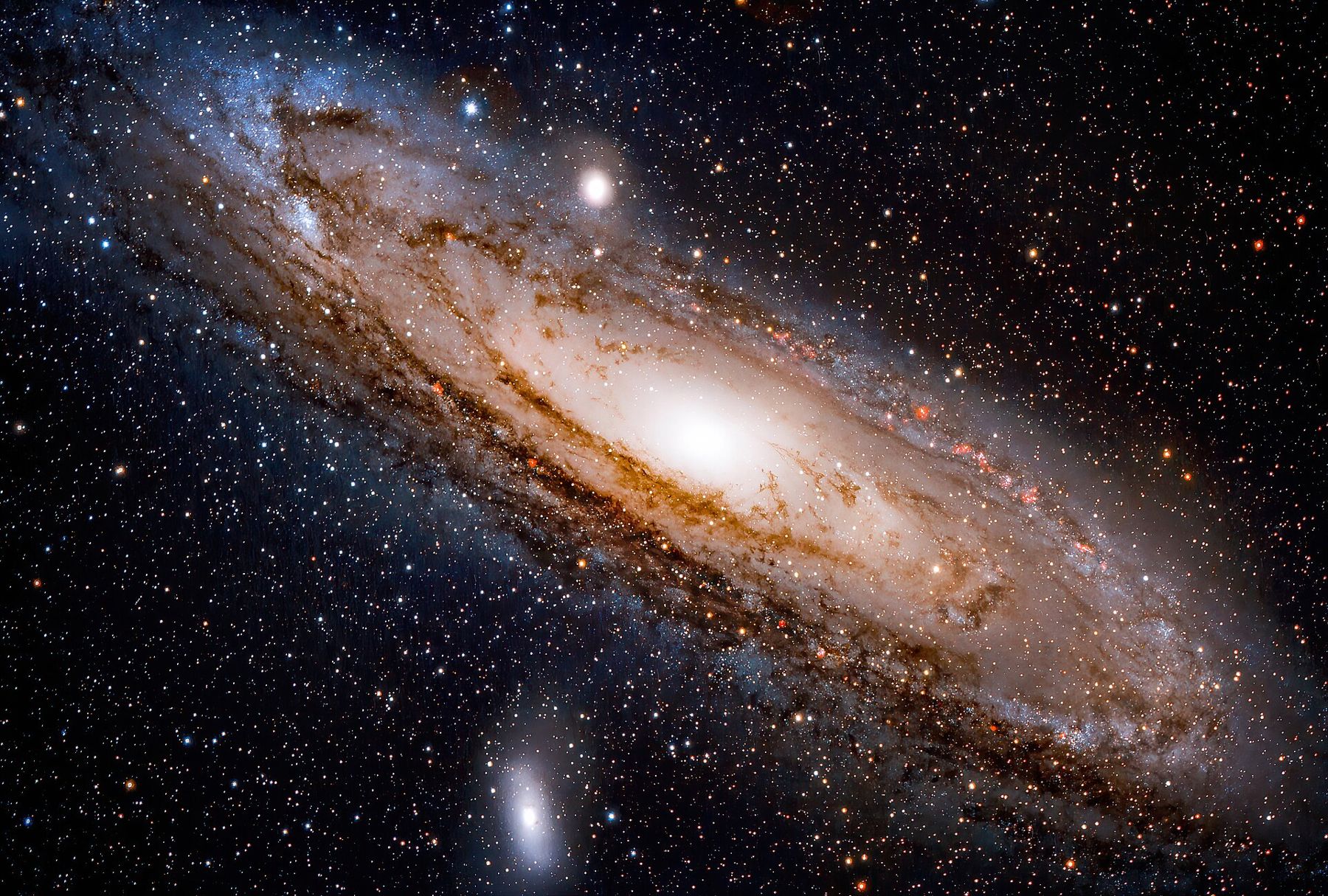
Do not expect the photographs. Long exposures gather light for hours and show spiral arms, dust lanes and color. Your eye shows something quieter: a soft, elongated patch with a brighter middle, like a breath on a cold window. That faint glow is the combined light of an entire galaxy, and seeing it for yourself is strangely moving.
The evenings it rides high
Andromeda is an autumn and early-winter evening object. In late summer it rises in the northeast during the evening and is best after midnight. Through October, November and December it climbs high in the early evening, and from Texas it passes close to the zenith, the point straight overhead, where the air is thinnest and the view is best. By late winter it is sinking into the northwest soon after dark.
The moon matters a great deal. Even a half moon brightens the sky enough to hide the faint outer glow. Plan for nights when the moon is down, around new moon or before a late moonrise. Give your eyes at least twenty minutes away from any bright light before you start searching.
Two ways in: Cassiopeia and Pegasus
From Cassiopeia
Find the W of Cassiopeia, high in the north on autumn evenings. The W is made of two V shapes side by side. Take the one whose point is the brightest of the five stars, Schedar. Imagine that V as an arrowhead and follow the direction it points, away from its open end, for roughly a fist and a half at arm's length. The galaxy lies there, in a fairly empty patch of sky.
From Pegasus
The Great Square of Pegasus is a large box of four fairly bright stars, high in the south and east on autumn evenings. Its northeastern corner star, Alpheratz, actually belongs to Andromeda. From Alpheratz, follow a gentle curve of stars leading away from the square and count two stars along it to reach Mirach. From Mirach, turn toward Cassiopeia and step up through two fainter stars. The galaxy sits just beyond the second, a little to one side.
TX-5 · Copper BreaksBig skies on the Rolling PlainsTry both routes. On a first night one usually works better than the other, depending on how high each part of the sky stands. Once you have found the glow, it is easy to find again for the rest of your life.
Looking slightly away
The center of your vision is built for detail and color, not for faint light. The cells best at catching dim light are spread around the edges of your view. Astronomers use this with a trick called averted vision: look a little to one side of the faint object, and it seems to brighten.
- Fix your gaze on a star a short distance from where the galaxy should be.
- Keep your attention on the faint patch without moving your eyes to it.
- If it vanishes, try looking off to the other side instead.
- Breathe slowly and relax. Tension and a craned neck both make it harder.
A reclining chair helps a great deal, since the galaxy stands so high. Lie back, let your eyes wander gently around the area, and give it time. Many people see the bright core first, then notice the glow stretching out to either side.
What binoculars add
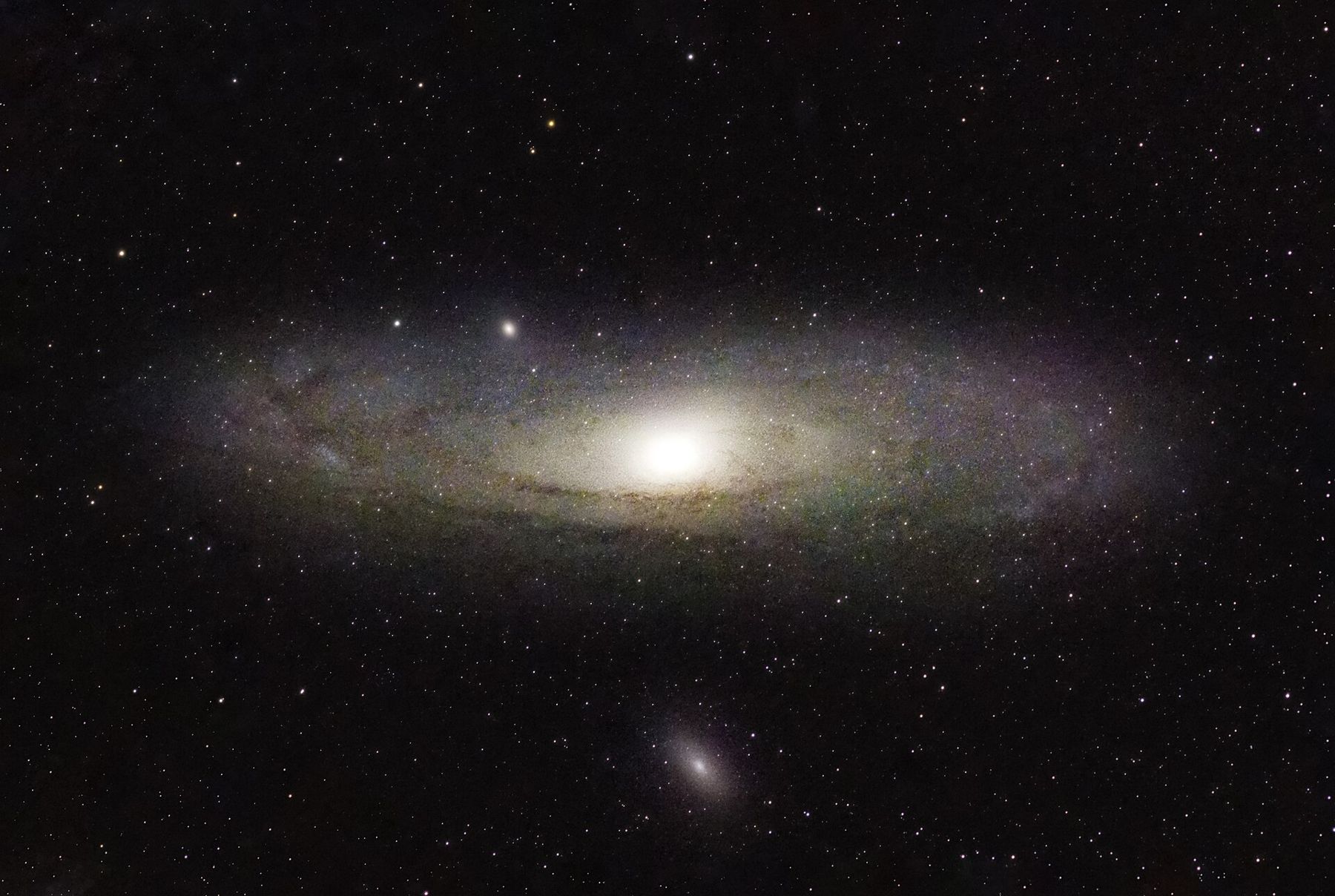
Ordinary binoculars, such as a pair marked 7x50 or 10x50, turn the faint smudge into an obvious glowing oval with a bright, star-like center. On a good night you may see that it is long and narrow, because the galaxy is tilted nearly edge-on to us. A small fuzzy star near the core may be M32, one of its companion galaxies.
Brace the binoculars against a post, or rest your elbows on your knees while you lie back, to steady the view. Then try for a harder target. The Triangulum Galaxy, Messier 33, lies roughly as far from Mirach as Andromeda does, but on the opposite side. It is large and very faint, and seeing it by eye is a real test of a dark sky. In binoculars it is a pale, round haze.
If you have a small telescope, the galaxy's core fills a low-power eyepiece, and setting up a small telescope on the river flats explains how to star hop to it. Large telescopes show little more color than your eye, which is something you will notice at a star party at the McDonald Observatory too.
Why Copper Breaks suits the search
Seeing Andromeda by eye depends far more on darkness than on eyesight. Under a suburban sky it is lost entirely. Under a rural sky it is a faint challenge. Under a sky like the one over the Rolling Plains, with no large city for many miles, it is plain once you know the spot.
Autumn is also a kind season here. The air is often dry and clear after a front, and the nights are long without the bitter cold of midwinter. Read more about the park in big skies on the Rolling Plains, and if you come in August, stay up late for the Perseids too; meteor nights on the granite covers how to watch them.
And when you find it, remember what you are looking at. The faint glow in your eye left its source before our species existed, and it has been crossing the dark ever since, only to end its journey here, tonight, in you.